



How much is damaged
Repair may be enoughA few shingles or one area
Replacement is worth discussingWear across several slopes
Roofing
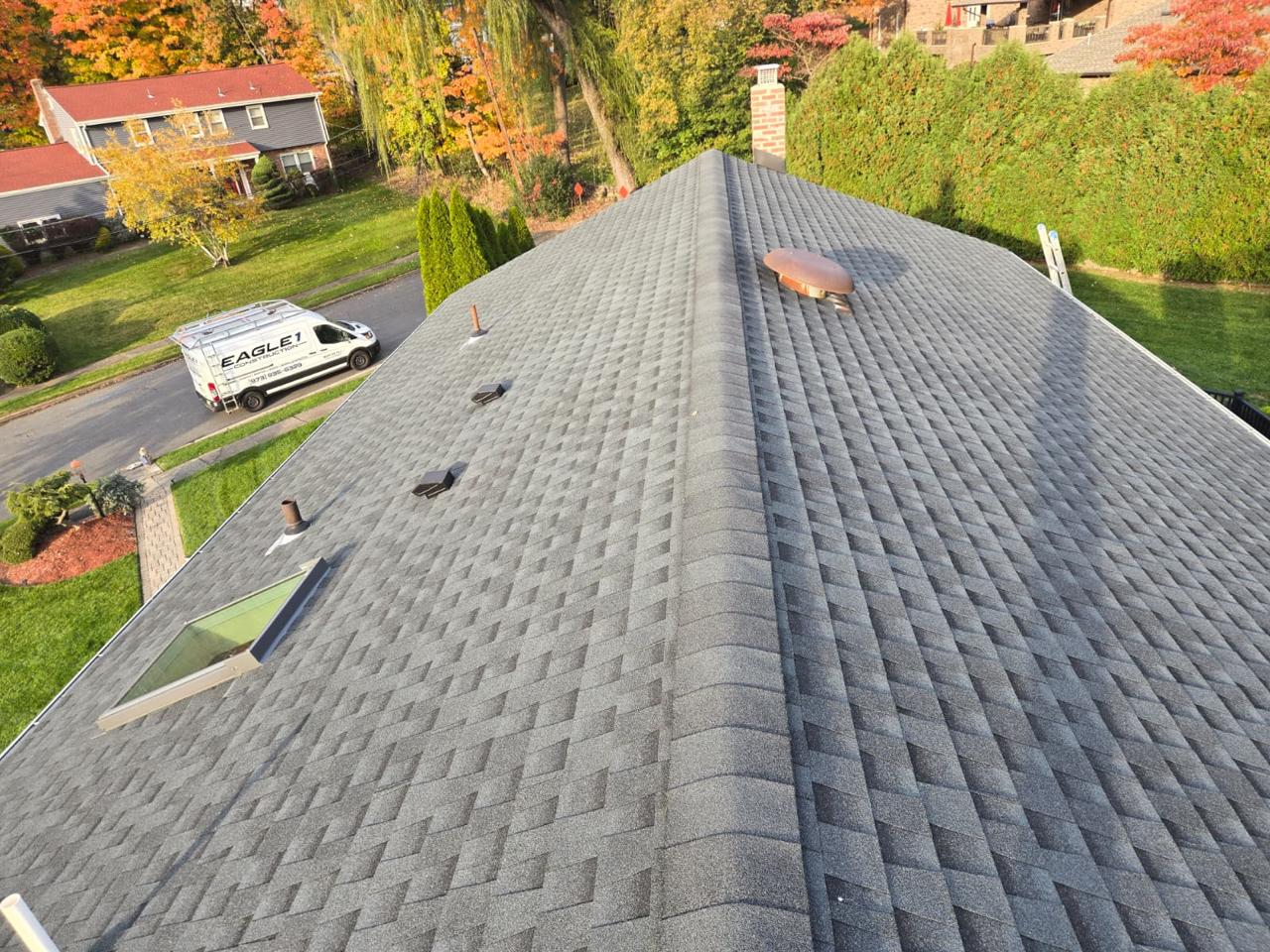
Eagle 1 Construction repairs and replaces roofs across North Jersey. A replacement here means the whole roofing system, not only new shingles: tear-off, a sound deck, underlayment, flashing, shingles, ridge caps and the details around vents, skylights and chimneys. The photos on this page come from our own jobs.
These six stages come from photos of our own jobs in East Rutherford and Leonia. They are shown in the order the work happens on the roof.
The old roofing comes off first, down to the deck or the framing. With the roof open, the crew can see what the old roof was hiding.
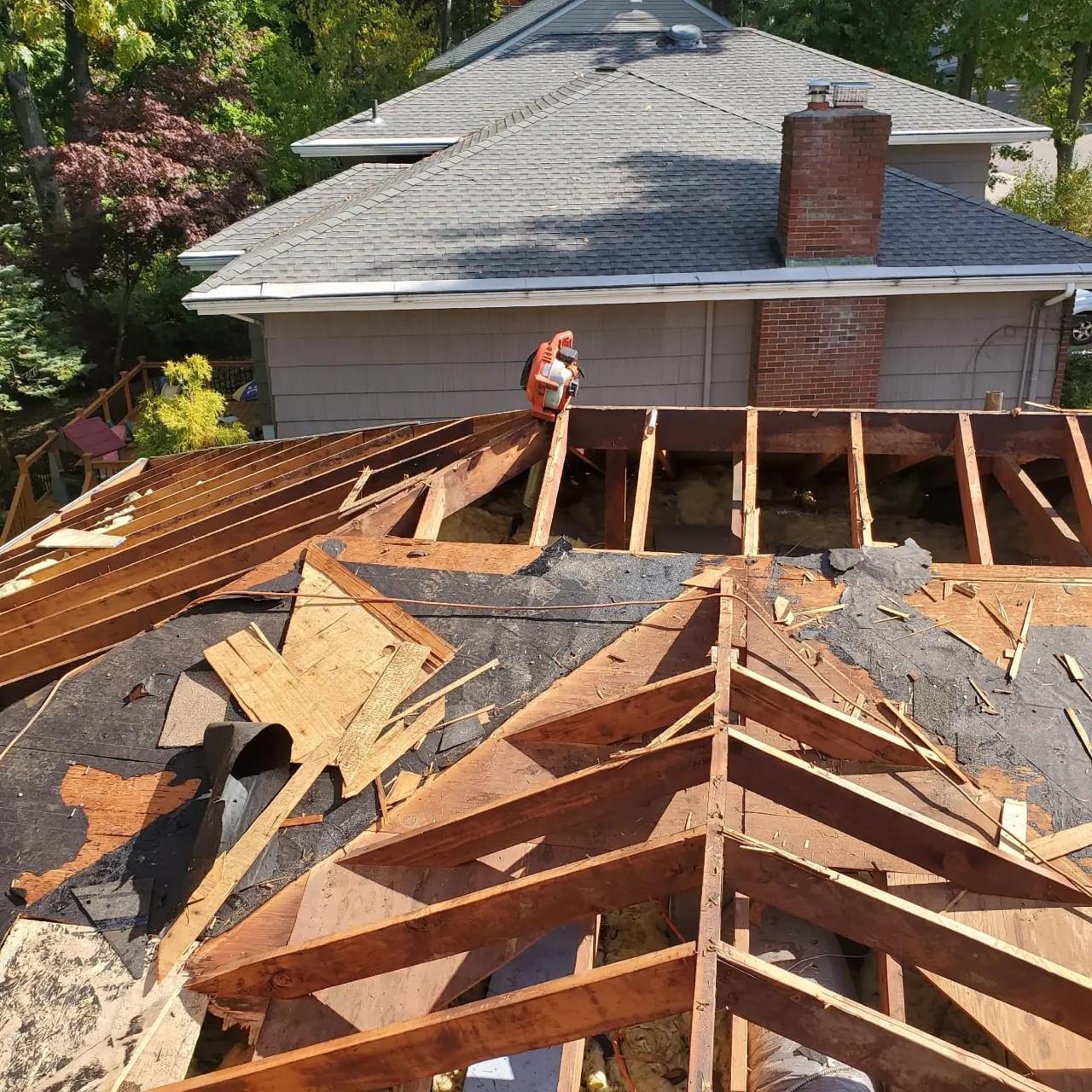
Where the deck needs it, new plywood goes down so the shingles sit on a flat, solid base.
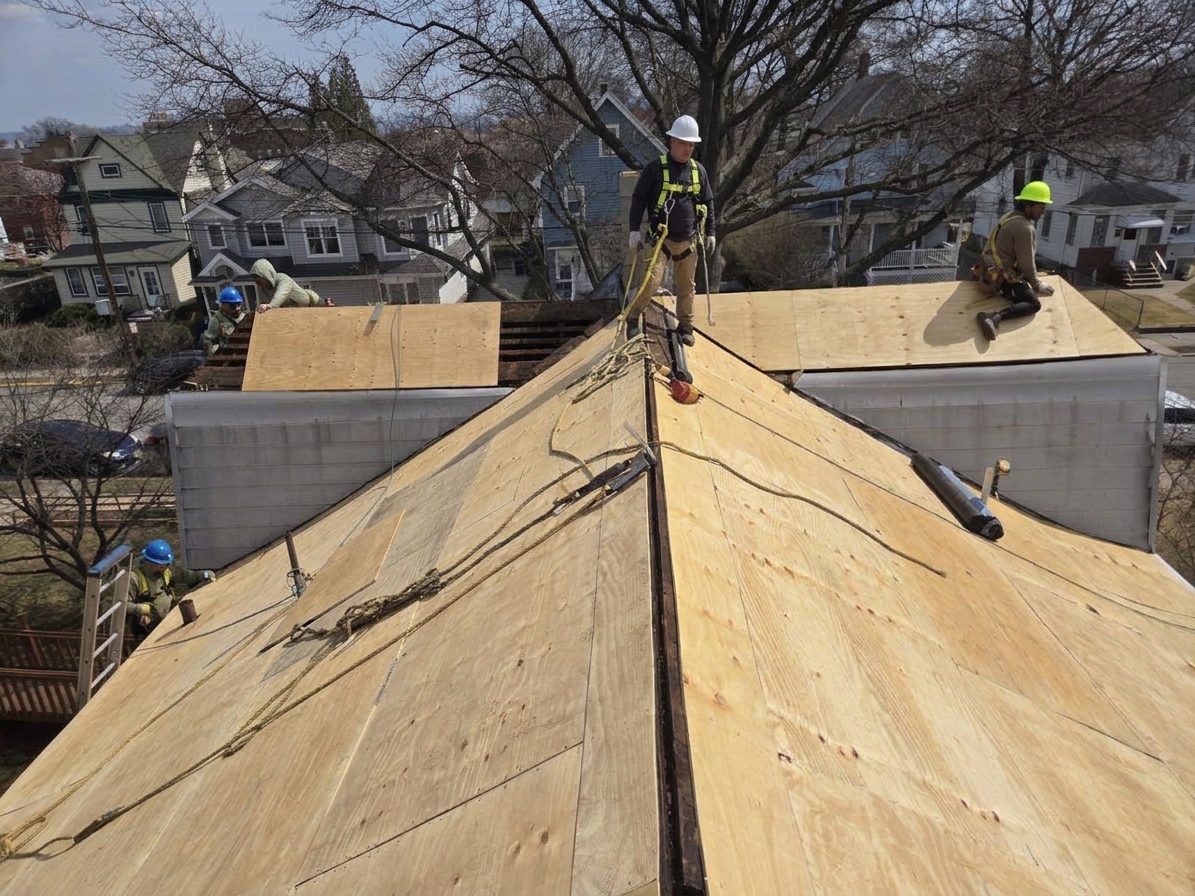
A synthetic underlayment is rolled out over the deck. It is the second layer of protection under the shingles.
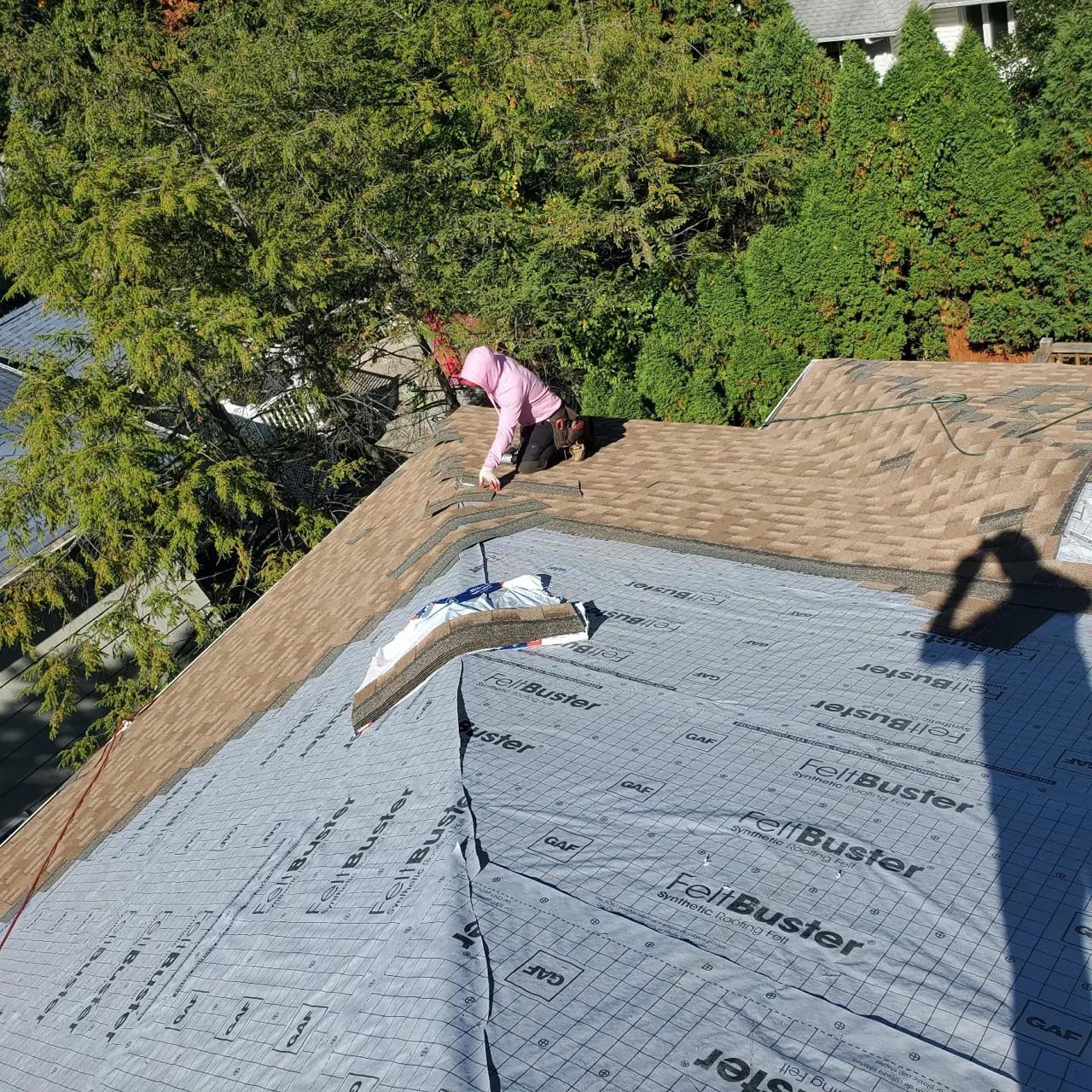
Shingles are laid in straight, overlapping courses, starting at the eave and working up each slope.
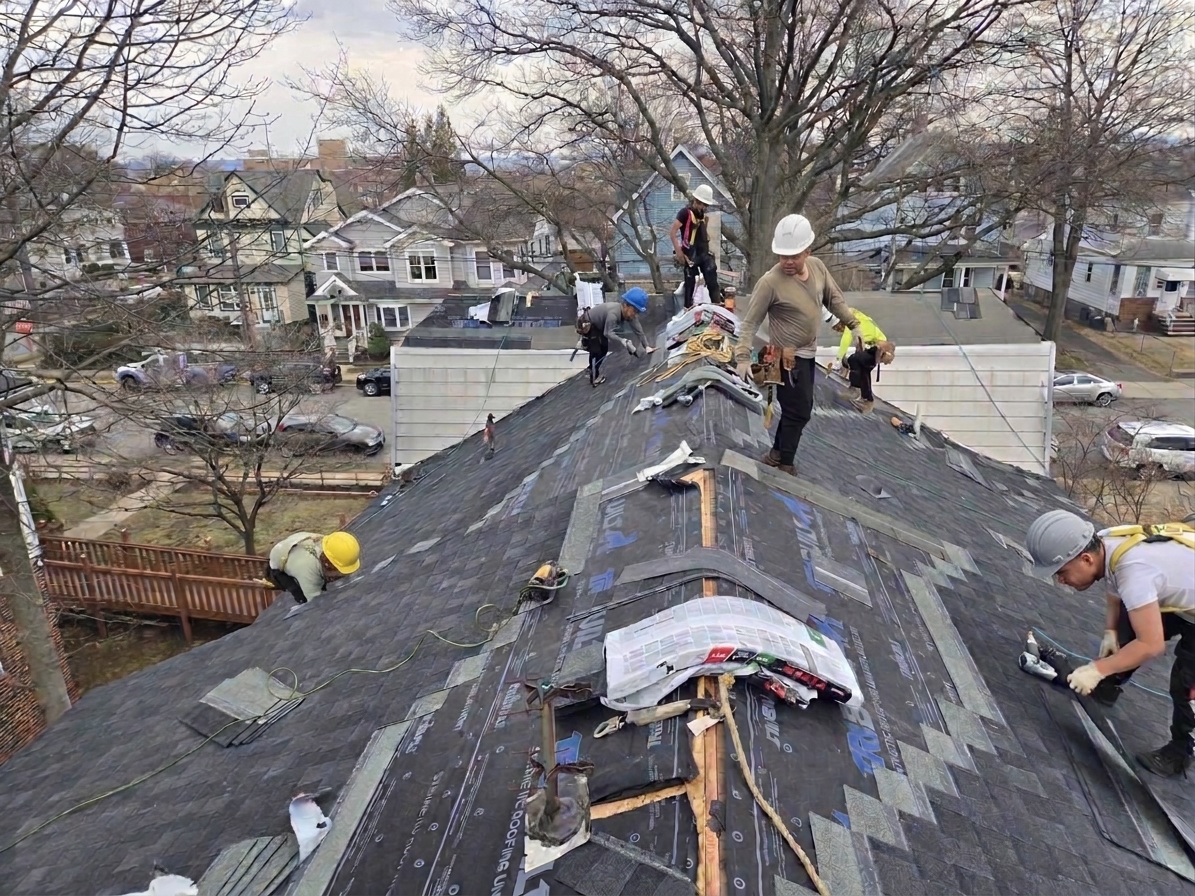
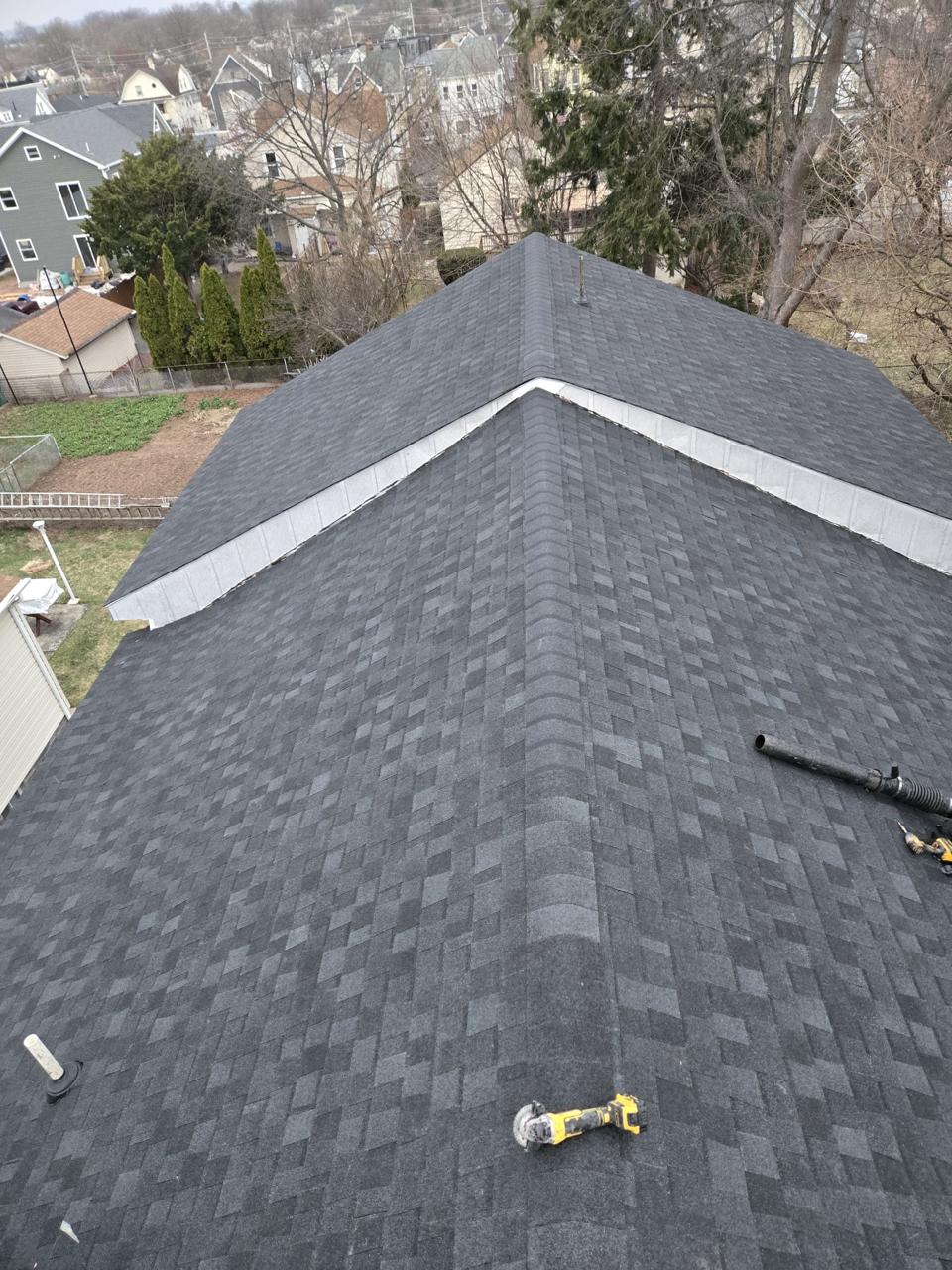
Cap shingles cover the ridge and the hips, which finishes the roof's peaks and lines.
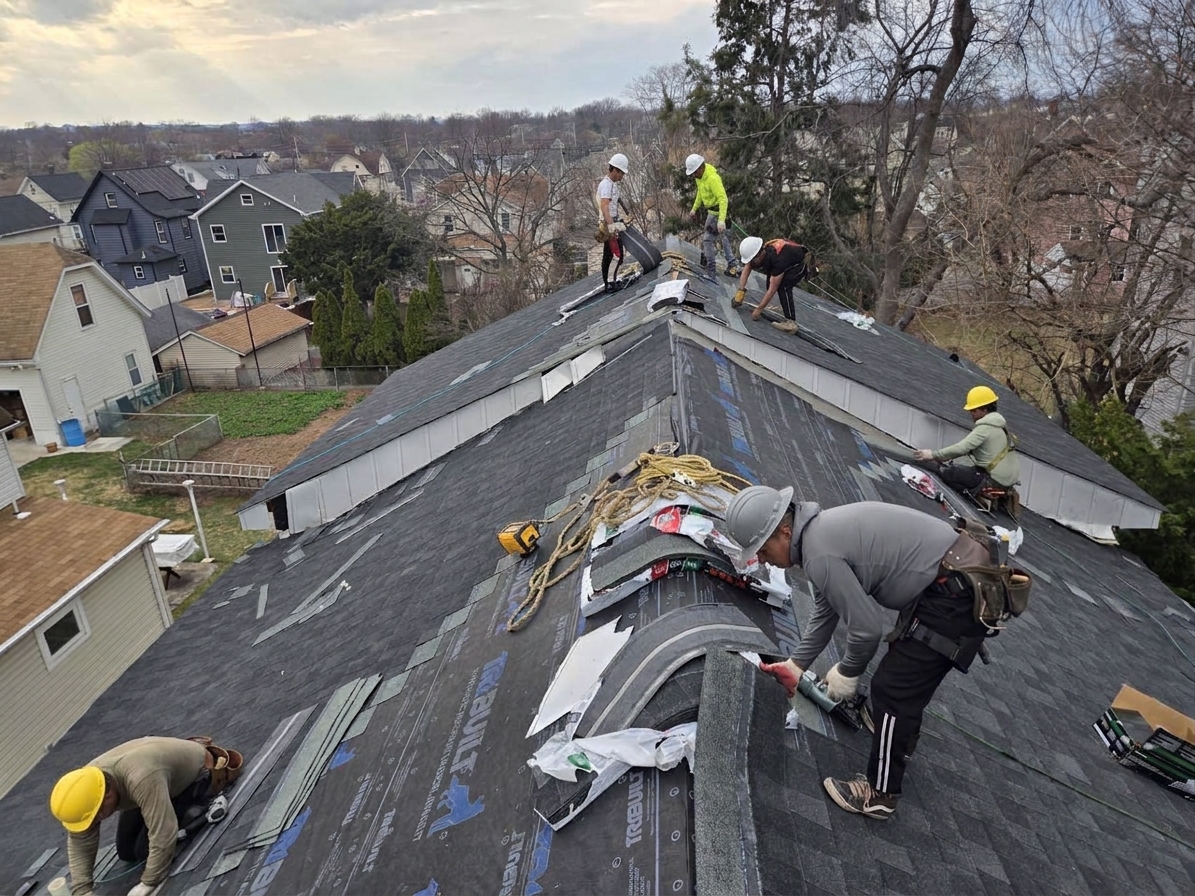
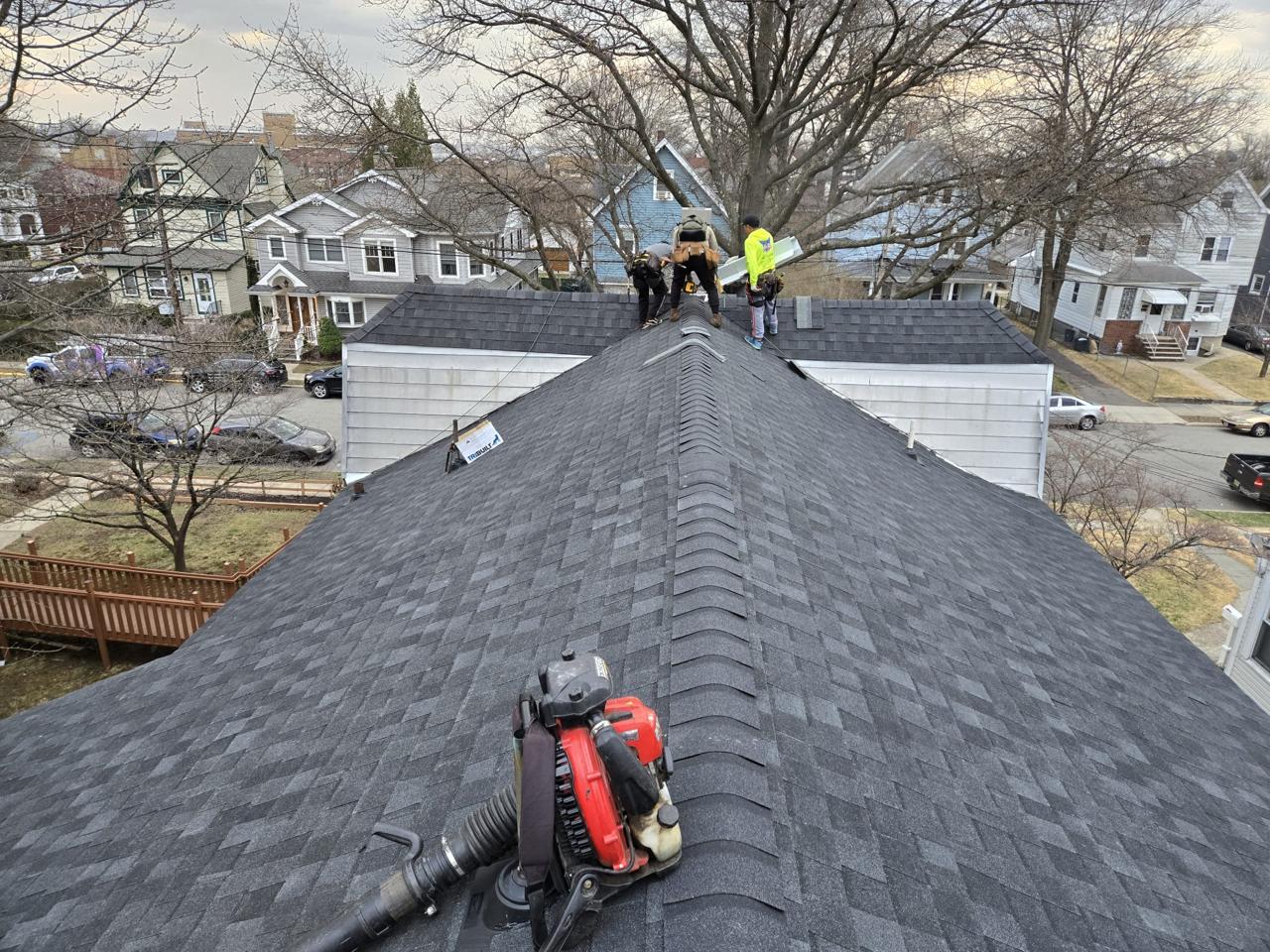
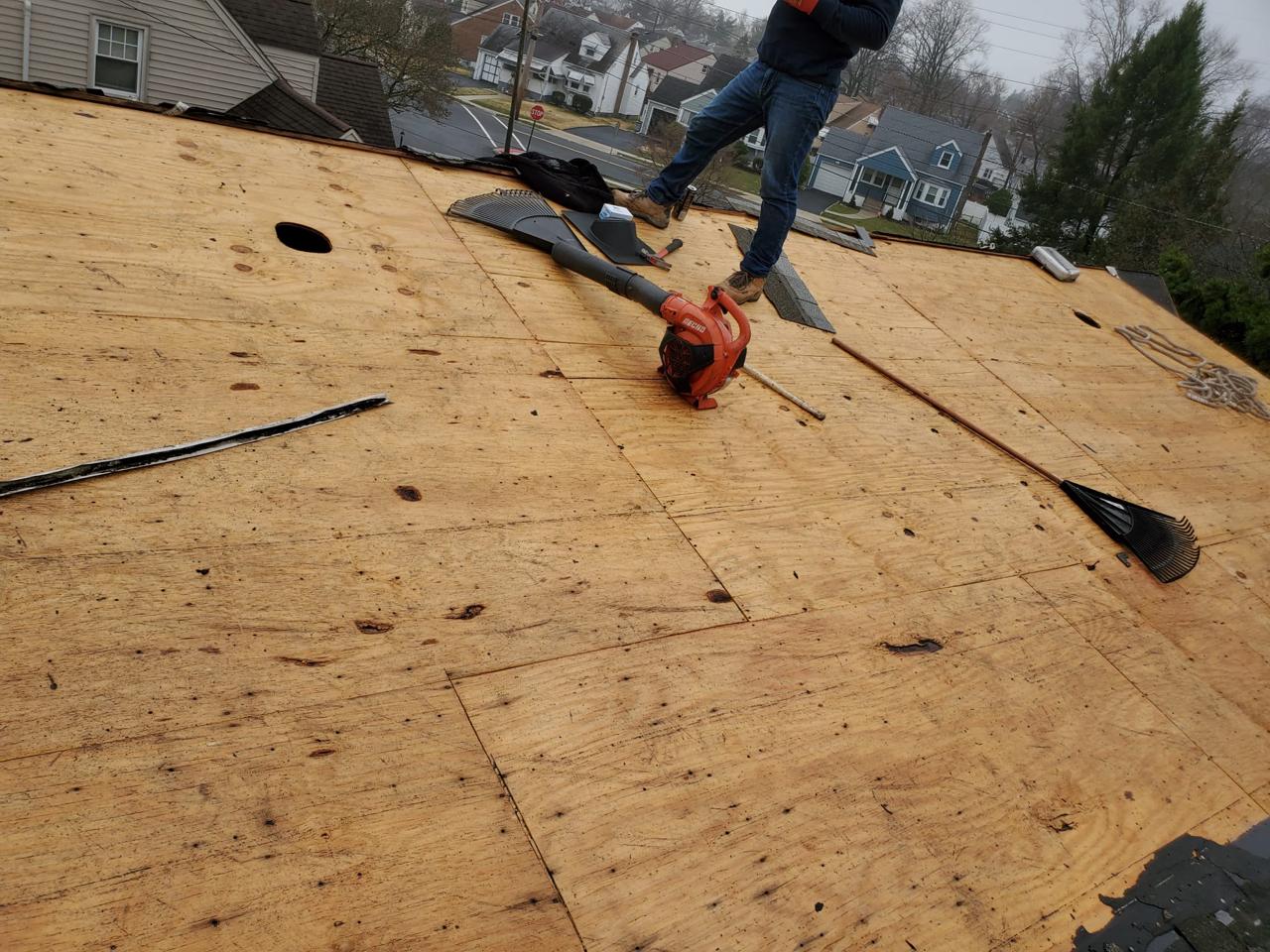
The roof is cleared of debris with a blower so the finished roof is left clean.
See roofs we have replaced: Roofing projects
A roof works hard all year. Sun, rain, wind, snow and the swing between hot and cold slowly wear down roofing materials. Shingles lose granules, turn brittle, curl or crack, and the flashing around walls, vents and chimneys can fail and give water a way in.
A professional replacement is more than a new surface. With the old roofing off, the crew can look at the deck, the underlayment, the flashing, the drainage edges and the ventilation, and decide what can stay and what must be replaced. That inspection happens under the shingles, where nobody can see it once the job is done.
The result you notice from the street, such as even courses, tidy edges and a clean ridge, comes from the work underneath. Planning matters most on roofs with several slopes, valleys, dormers or ridges, because every change of direction needs its own detail.
Few houses have a single flat slope. Hips, valleys, dormers, porch roofs and additions each create a place where two roof planes meet, and water behaves differently at each one. Before shingles go on, a good contractor walks the roof and maps those places: where the ridges run, where valleys collect runoff, where walls rise out of the roof, and where pipes, vents, skylights or chimneys come through.
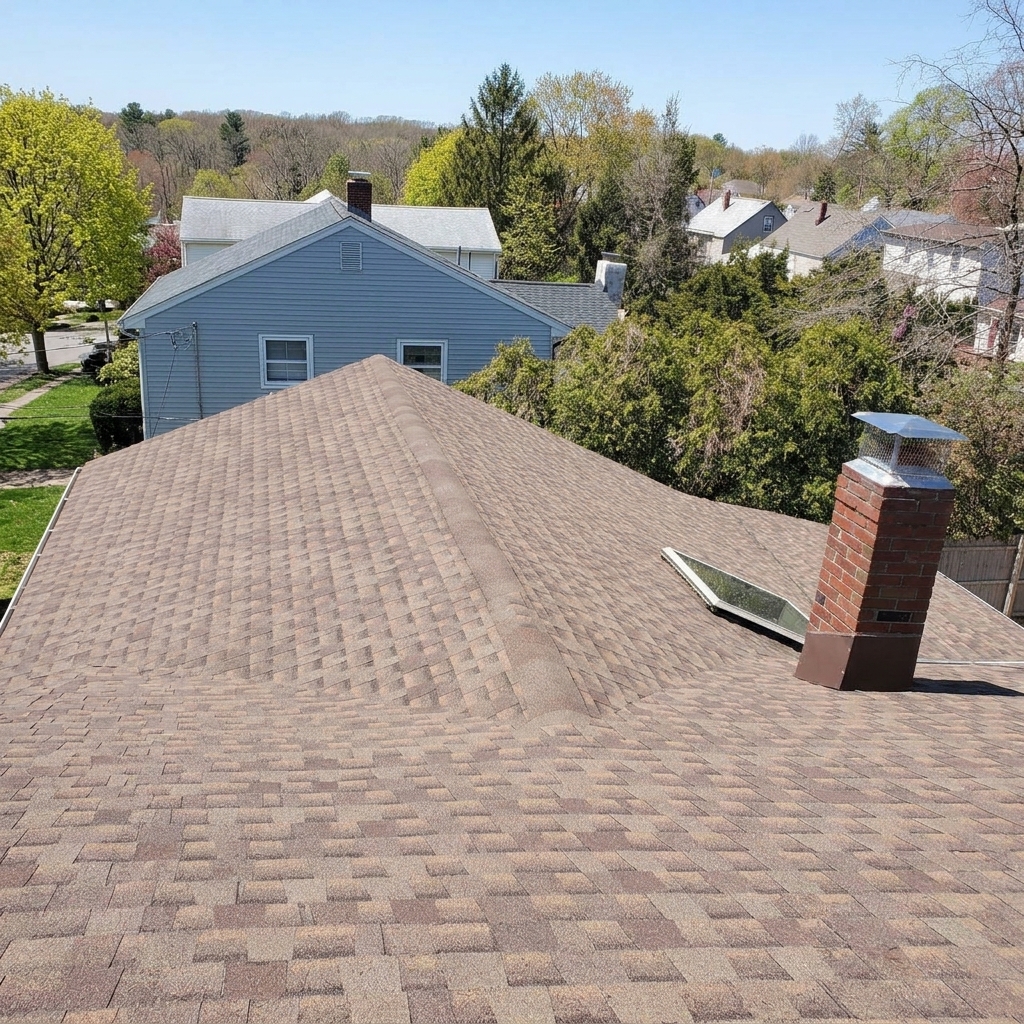
That map sets the order of work and the materials. Measurements cover the total roof area, the pitch, a waste allowance, the length of ridges and hips, and the valleys, so the right amount of material arrives with the first delivery. On a hip roof like the one in the photo, long hip lines and several planes mean more cutting and more cap work, and careful planning shows in the finished lines.
Asphalt shingles are a common choice for homes because they come in many colors, profiles and performance levels. Color gets the attention, but the product behind it matters more: its expected service life, its wind rating, its warranty terms and how it is meant to be installed.
Each shingle product has its own exposure, nailing zone and starter requirements, and the manufacturer's instructions govern all of them. Ask which product is proposed for your roof and why, and ask how it will work with the underlayment, ridge caps and vents so every part is compatible.
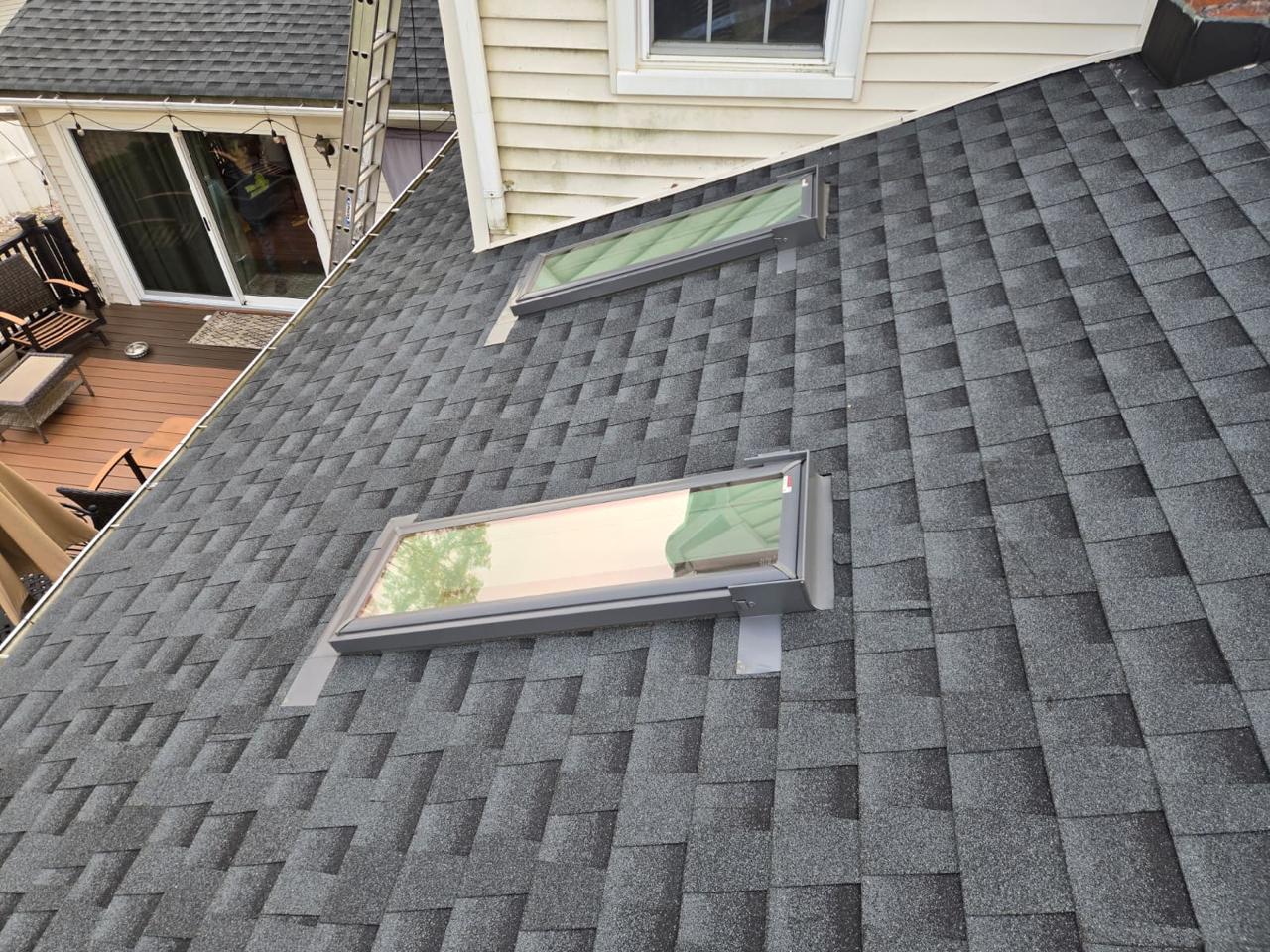
Straight shingle lines are the quickest visual check of a careful installation. They come from measuring, snapping reference lines, keeping the exposure the manufacturer specifies and checking alignment as the work climbs the roof. On a large roof, a small drift at the eave becomes a visible curve at the ridge.
Alignment is not only about looks. Fasteners have to land in the nailing zone printed on the shingle, in the right number and type, driven flush. The requirements change with the product, the slope and local code, so installers should follow the instructions for the shingle on your roof rather than one habit for every job.
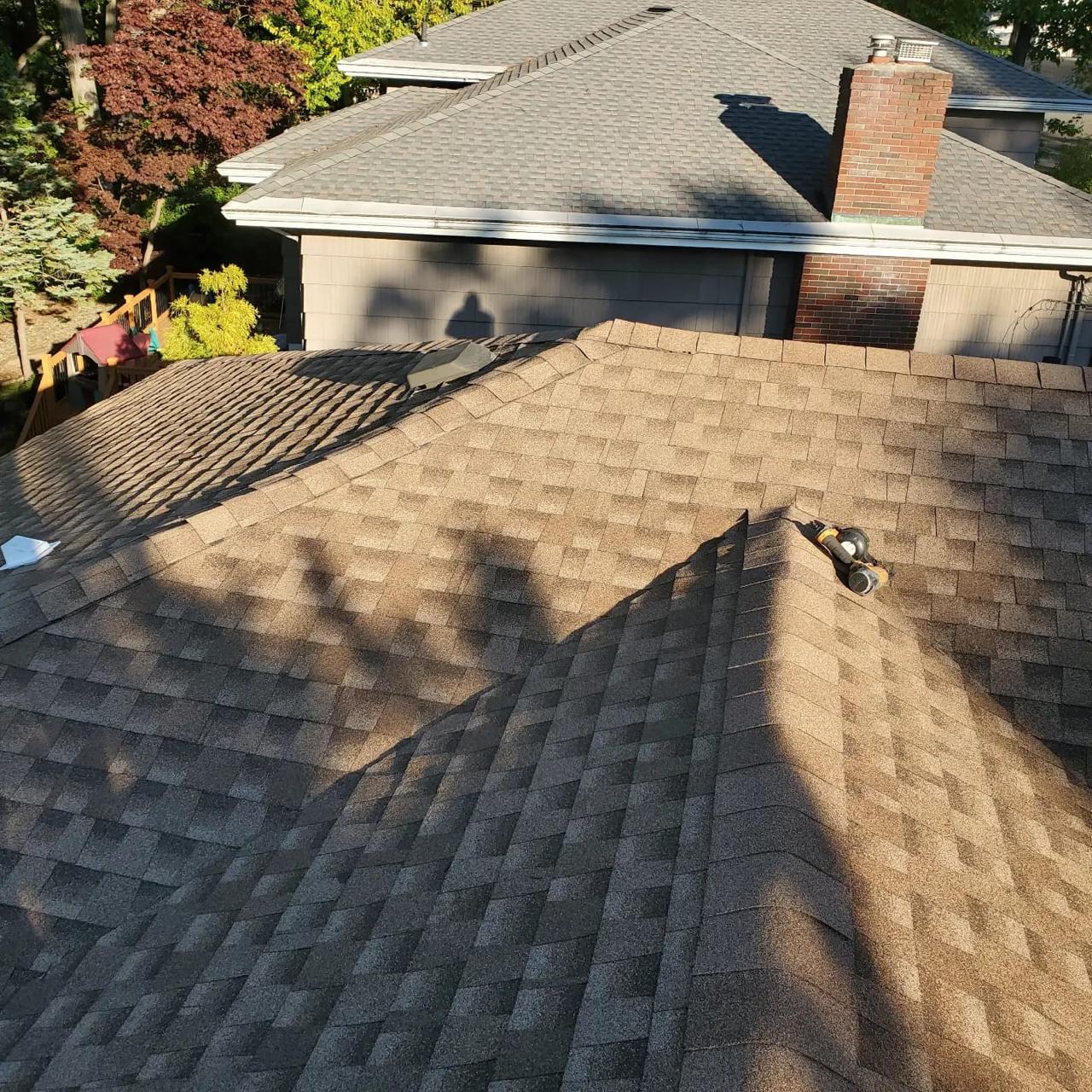
Ridge caps cover the line where two roof planes meet at the top, and they finish the hips too. They protect that joint and give the roof its outline, the layered line you can see on the roofs in our photos. Their placement, overlap, fastening and alignment all affect both the look and the protection.
On some roofs the ridge is also part of the ventilation system. If a vented ridge is used, it has to be planned together with the attic's air intake, because a ridge cap by itself does not tell you whether a roof is ventilated well. Ridge components also need to be compatible with the shingles below them and installed in the order the system calls for.
A valley is where two slopes meet in a V and the runoff from both runs down the same line. Water concentrates there, so valleys get extra attention. Depending on the roof and the shingle product, a valley may be lined with metal flashing or finished with a manufacturer-approved shingle method. Either way, the choice and the installation have to follow the product's instructions.
Intersections also include places where a roof meets a wall, a dormer or a lower roof. Each one is checked for loose material, damaged flashing and uneven surfaces that could trap water or push it sideways. These areas are small next to the main shingle field, and they are common places for leaks to start.
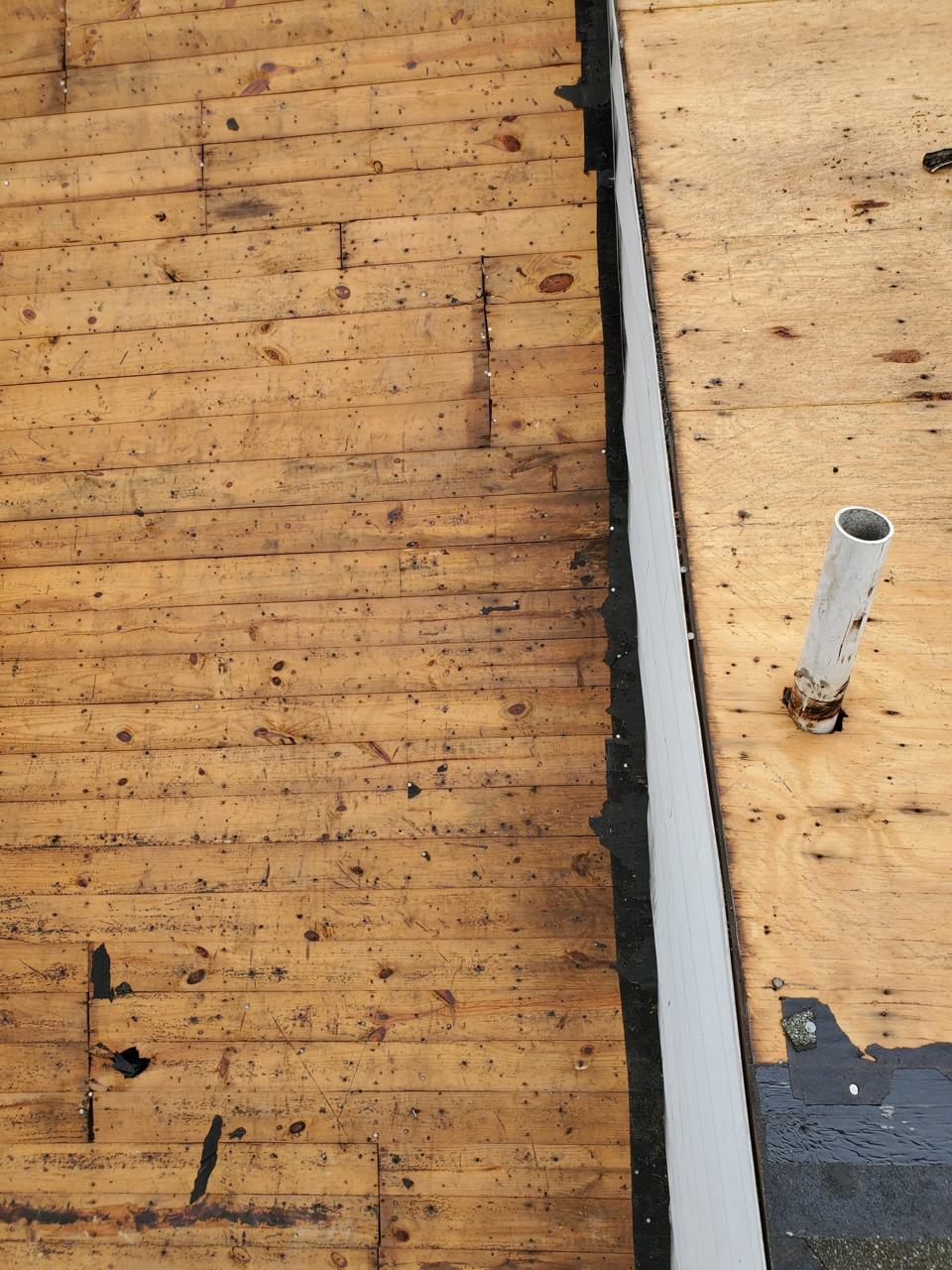
The deck is the surface everything else is fastened to. Once the old shingles are off, it can be seen: loose or damaged panels, wood that has soaked up moisture, boards that no longer hold a nail. Those areas need to be repaired or replaced before anything goes on top.
The photos from East Rutherford show what this looks like: older plank decking next to new plywood, and a bare plywood deck after it was cleaned off with a blower. Edges, ridges and valleys are checked at the same time, and so is whether the existing flashing and drainage parts can stay.
How much decking work a roof needs depends on its condition, and not every replacement needs much. Ask your contractor how extra deck work is priced and approved before it starts.
Shingles shed most of the water, but underlayment is the second line of defense if water gets underneath. It protects the deck while the roof is being built and after it is finished. The right product depends on the roofing material, the slope, the climate, local code and the manufacturer's requirements. Some areas, such as eaves and valleys, may call for a more water-resistant membrane.
Installation matters as much as the product. Underlayment has to lap in the right direction, be fastened correctly and tie into the flashing around the roof. Step three above shows synthetic roofing felt rolled out across a roof in Leonia. Once the shingles are on, this layer is hidden, so ask for photos or an explanation of what went under them.
Weather protection matters during the job too. A partly open roof has to be planned so the structure is protected if the weather turns.
Flashing is the metal that guides water away from joints where the roof meets something else: a wall, a chimney, a pipe or a skylight. A roof can look perfect across the field of shingles and still leak at one badly sealed joint, which is why flashing deserves its own inspection during a replacement.
Existing flashing is inspected, not assumed. Whether it is reused or replaced depends on its condition and on whether it works with the new roof. Drip edge along the eaves and rakes helps send water off the roof's edge, walls may need step flashing and counterflashing, and chimneys and skylights have flashing parts of their own.
Two of our photos show this: white metal flashing along a wall on an East Rutherford roof, and brown metal flashing at the base of a brick chimney on a Bloomfield roof.
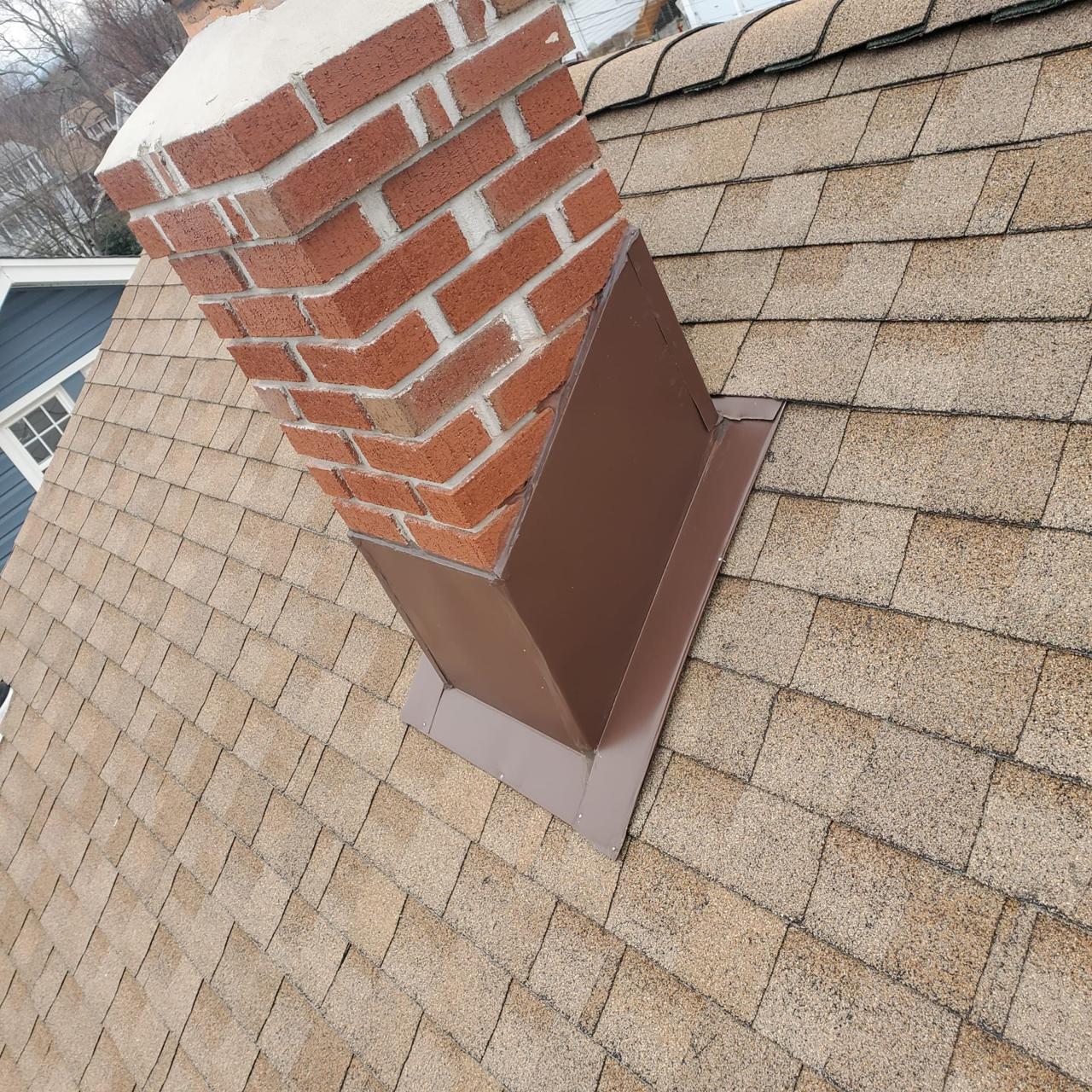
A chimney is both a roofing detail and a masonry structure, so two trades meet there. The roof side is the flashing, the metal that wraps the base so water cannot run down beside the brick. The masonry side is the brick, the mortar and the crown at the top, which shed water away from the flue and the stack.
Chimney repair and rebuilding is its own job, shown on our chimney projects page. When a chimney and a roof are done around the same time, the flashing can be fitted to the finished masonry, which keeps the joint between them simple.
Chimney work has its own pages: Chimney services and Chimney projects.
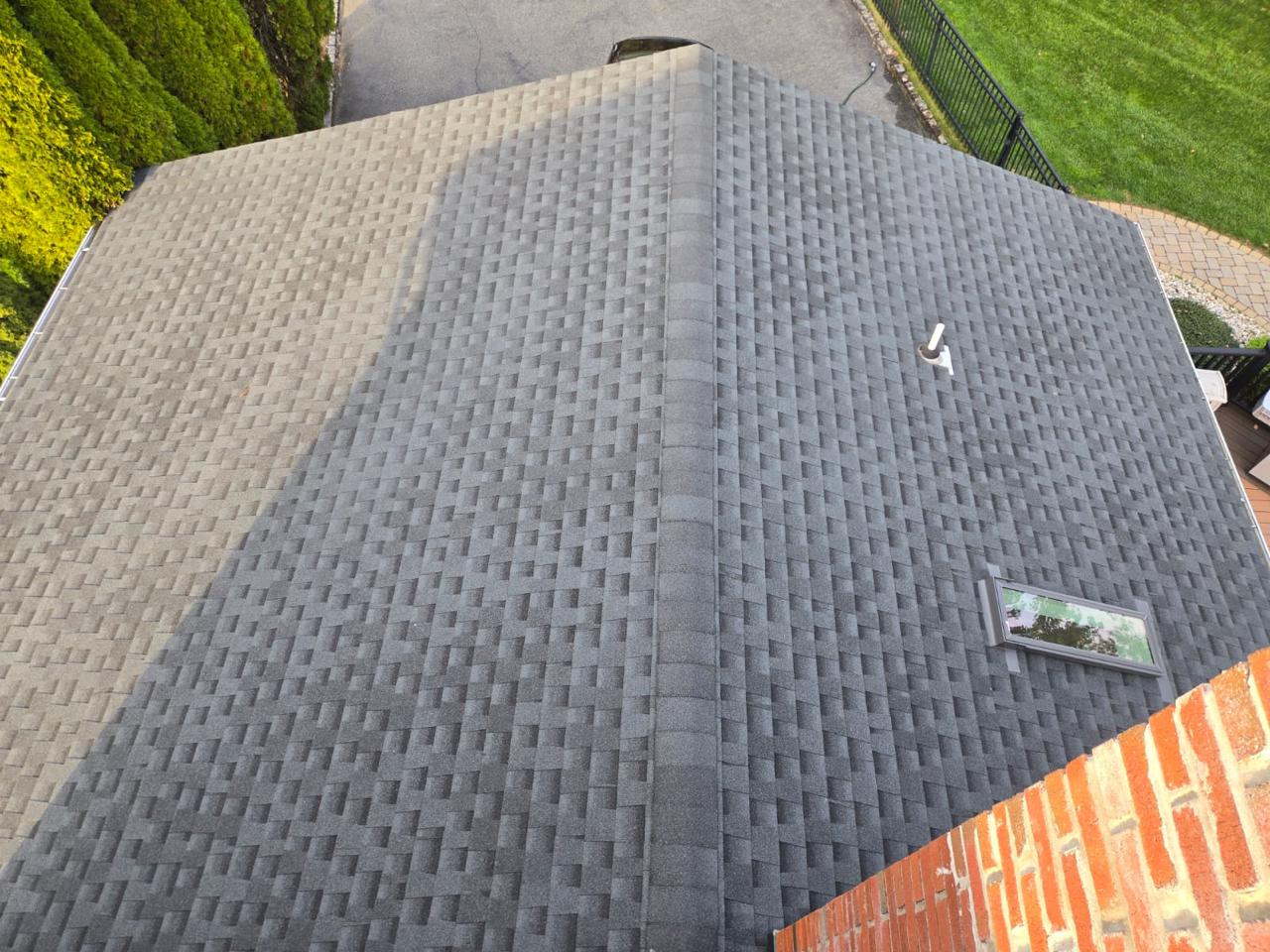
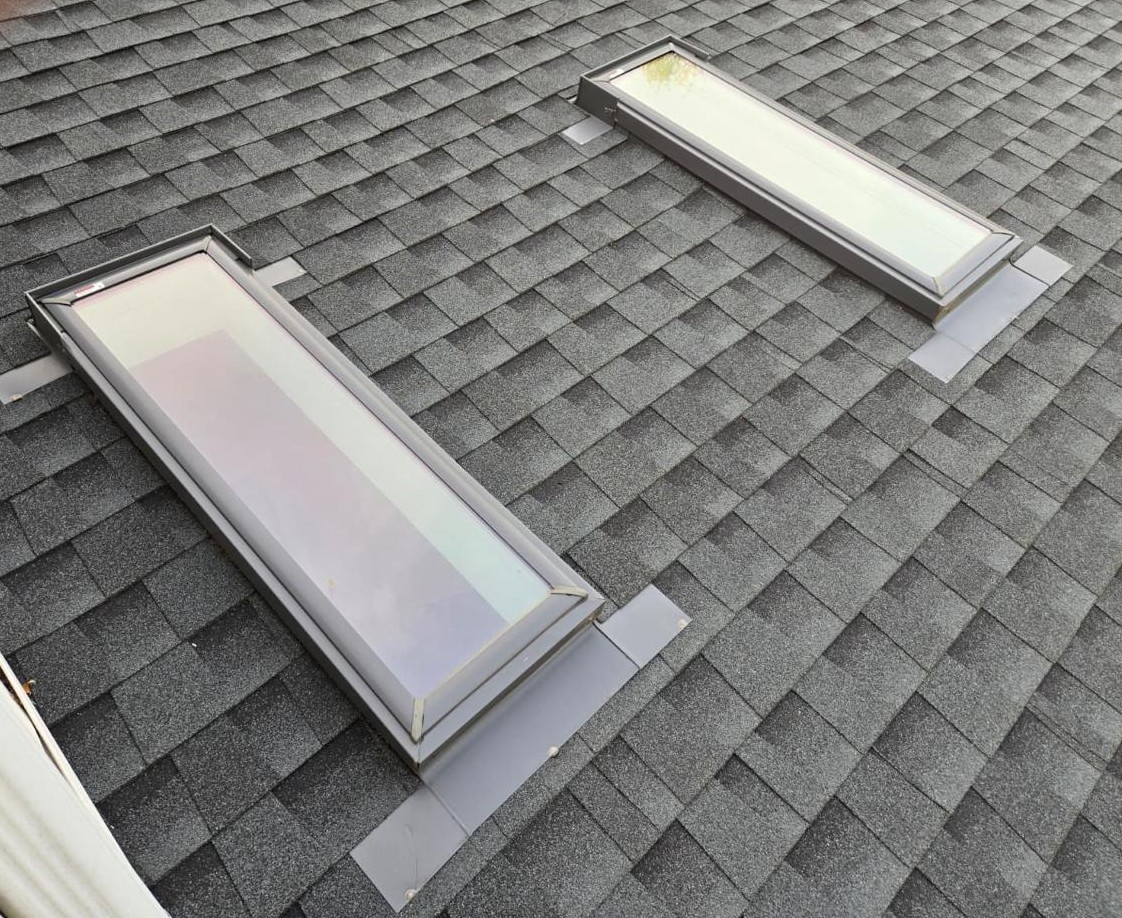
A skylight is a window in the roof, and a roof is not a forgiving place for a window. The frame needs flashing that fits the shingle pattern around it, and the roof around it must be built so that water goes around the opening rather than into it. That is why skylight work belongs with the roofing.
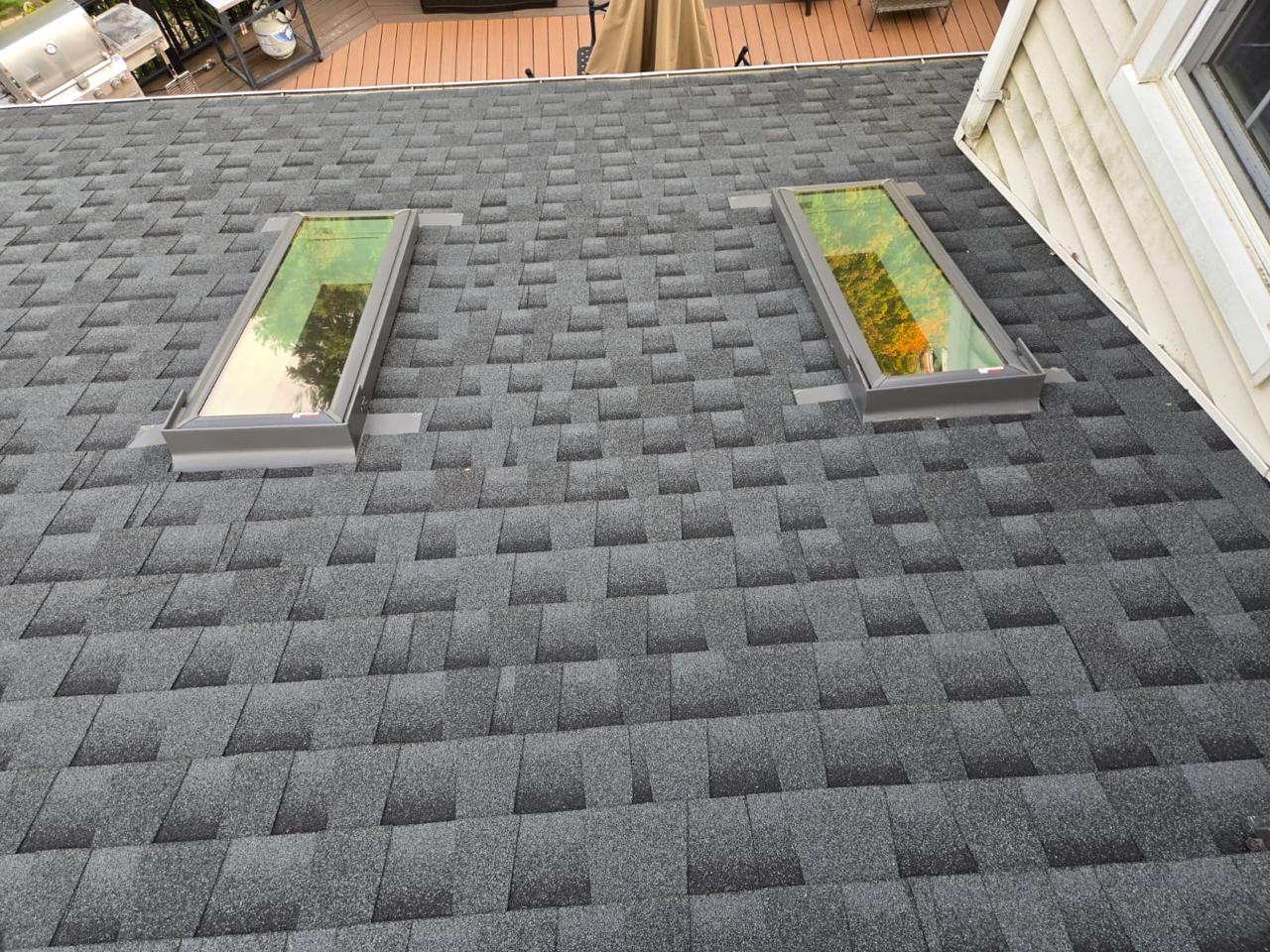
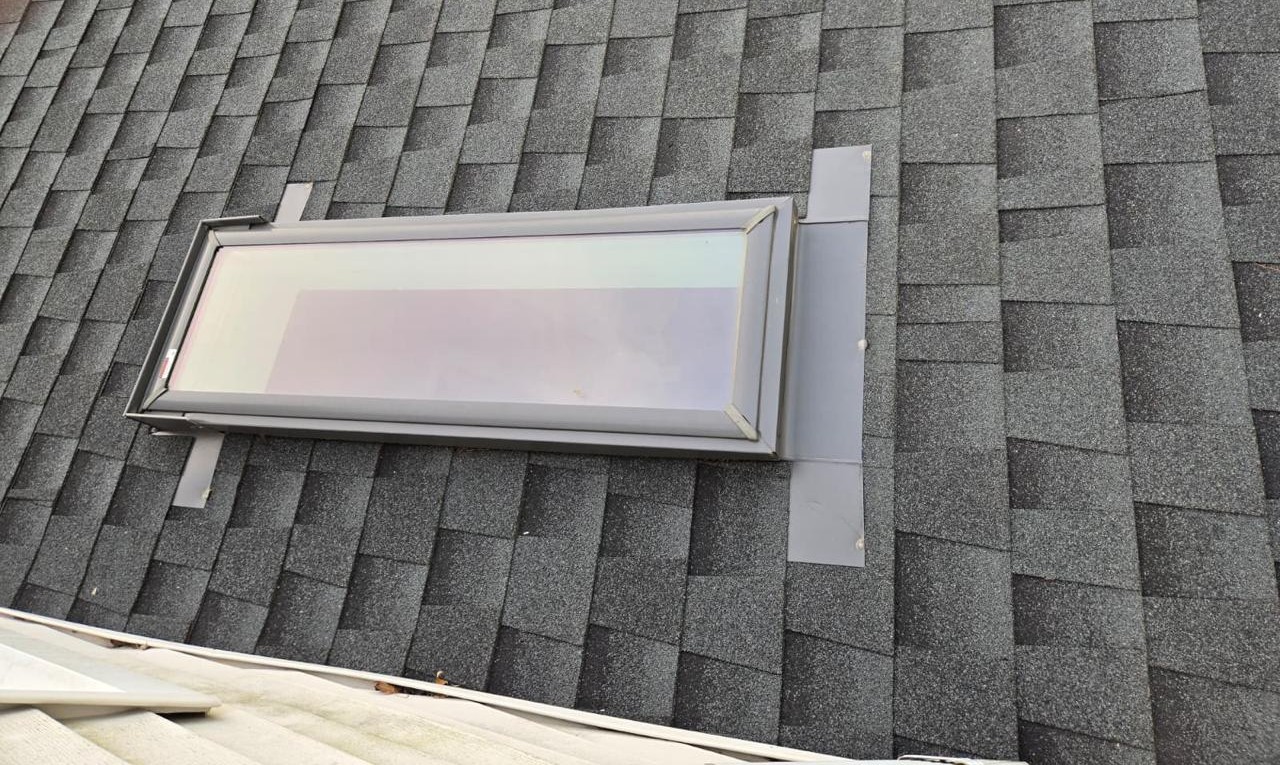
The two skylights in our Wayne photos were set into the new roof with metal flashing along each frame, and the close-up shows that flashing fitted into the shingle courses. If you plan to add or replace a skylight, ask how it will be flashed and how the roof around it will be finished.
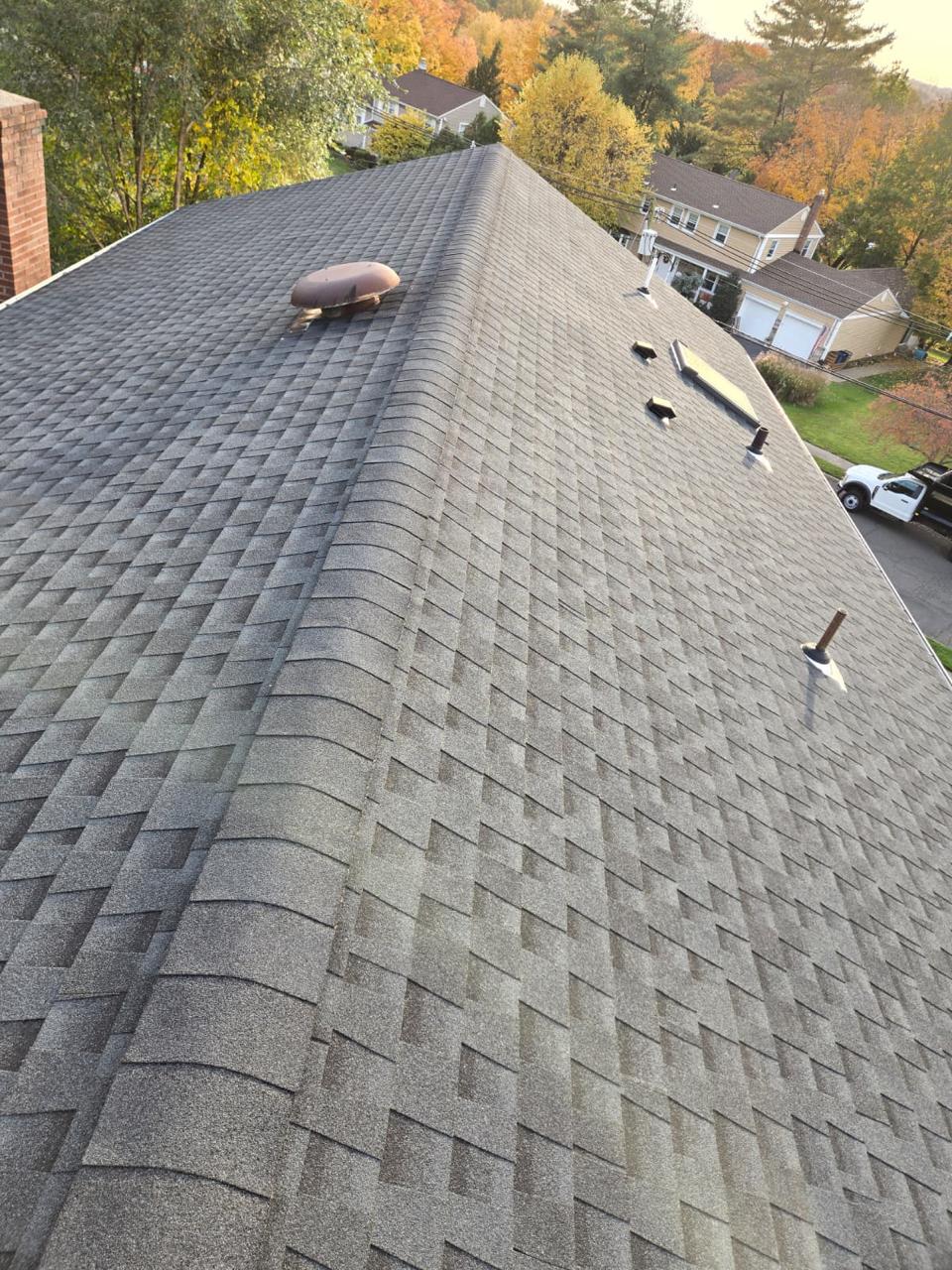
A roofing system should deal with moisture and, where the attic is ventilated, with airflow. In a typical ventilated attic, intake openings and exhaust openings work together. Adding one exhaust vent does not fix a system that has no intake.
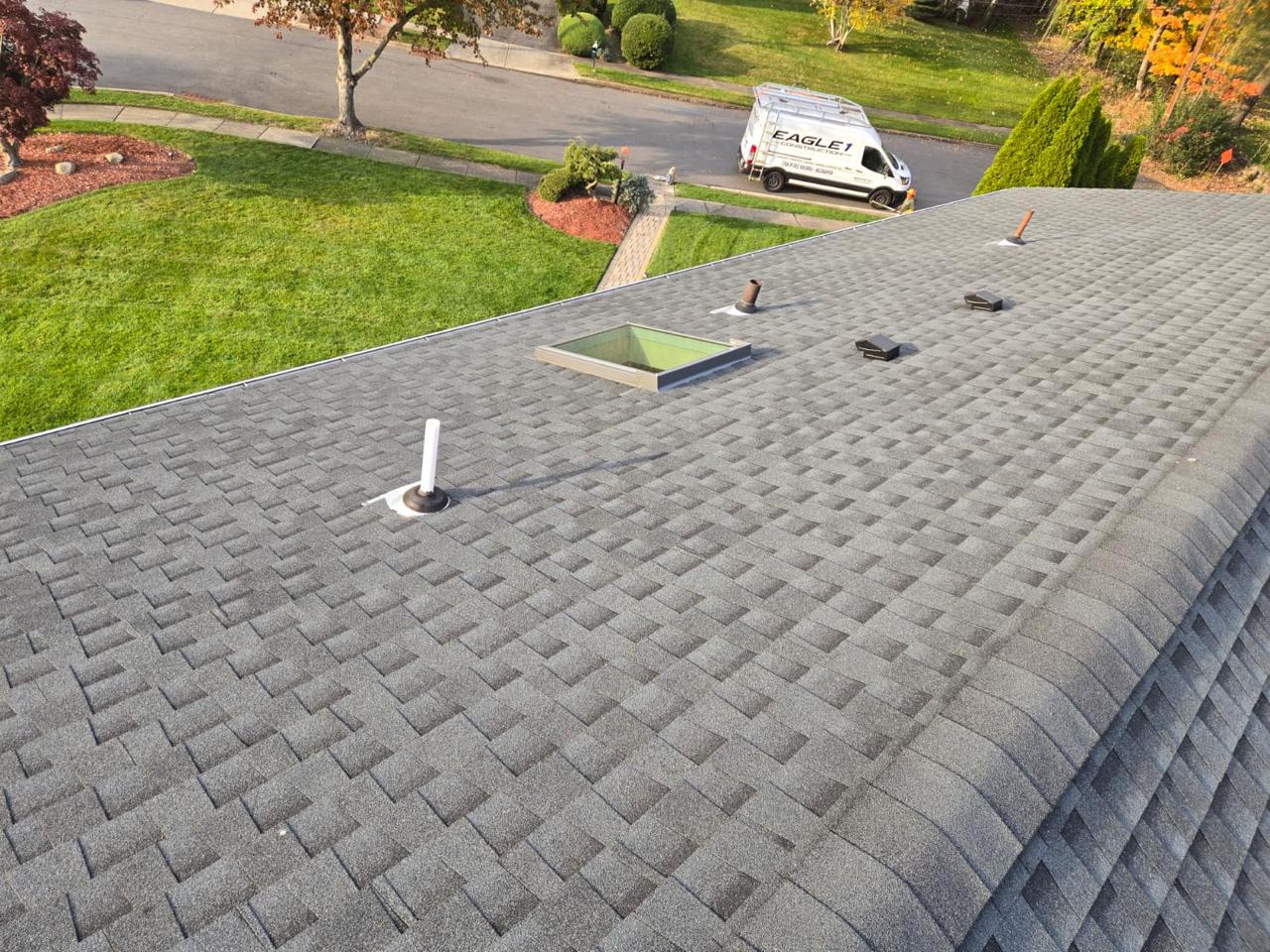
Insulation and air sealing belong in the same conversation, because warm, moist air leaking up from the living space is a common source of attic moisture. The photo shows the parts you can see from above: box vents, vent pipes, a skylight and the ridge. What is inside the attic has to be checked from inside.
During a replacement a contractor may spot ventilation concerns and suggest a closer look. Any change should be based on the actual building and local requirements.
A well-installed roof still lives in the weather. Keep gutters and downspouts clear so water drains away from the roof edge; our gutter service covers that side. After a storm, look from the ground for missing shingles or fallen branches, and stay off the roof. A steep roof is not a safe place to investigate.
Inside, watch for ceiling stains, damp attic surfaces or unexplained moisture. Plumbing leaks and condensation can look the same, so find the source before choosing a repair.
Most roof problems start small and out of sight. Some signs can be seen from the ground, some from the attic, and some only when the old roofing comes off. Knowing what to look for helps you act before a small repair becomes a larger one.
From the ground, look for shingles that are missing, curled, cracked or lifting at the corners, bare patches where the granules have worn away, and granules collecting in your gutters or at the base of downspouts. Dark streaks and green growth are common on older roofs. They are usually a sign that the surface holds moisture, so have the roof looked at rather than assuming it is only cosmetic.
Inside the house, look for ceiling or wall stains, peeling paint near the top of a wall, a musty smell, damp insulation or daylight coming through the attic boards. Check around chimneys, skylights, vent pipes and walls too, because those joints are where leaks often start.
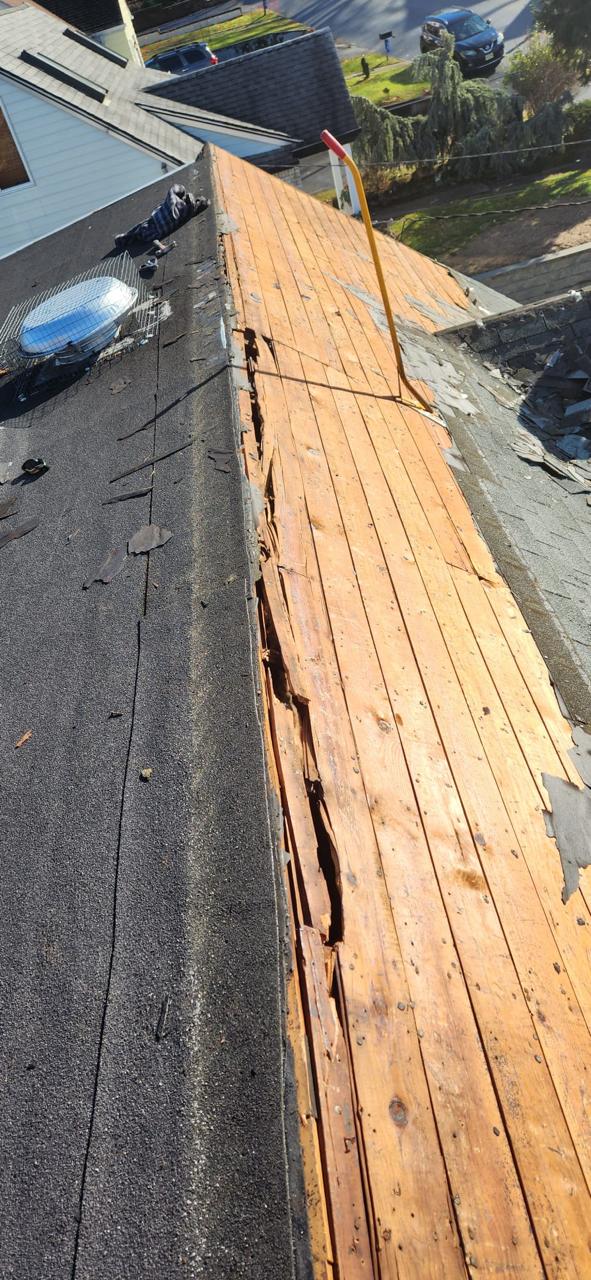
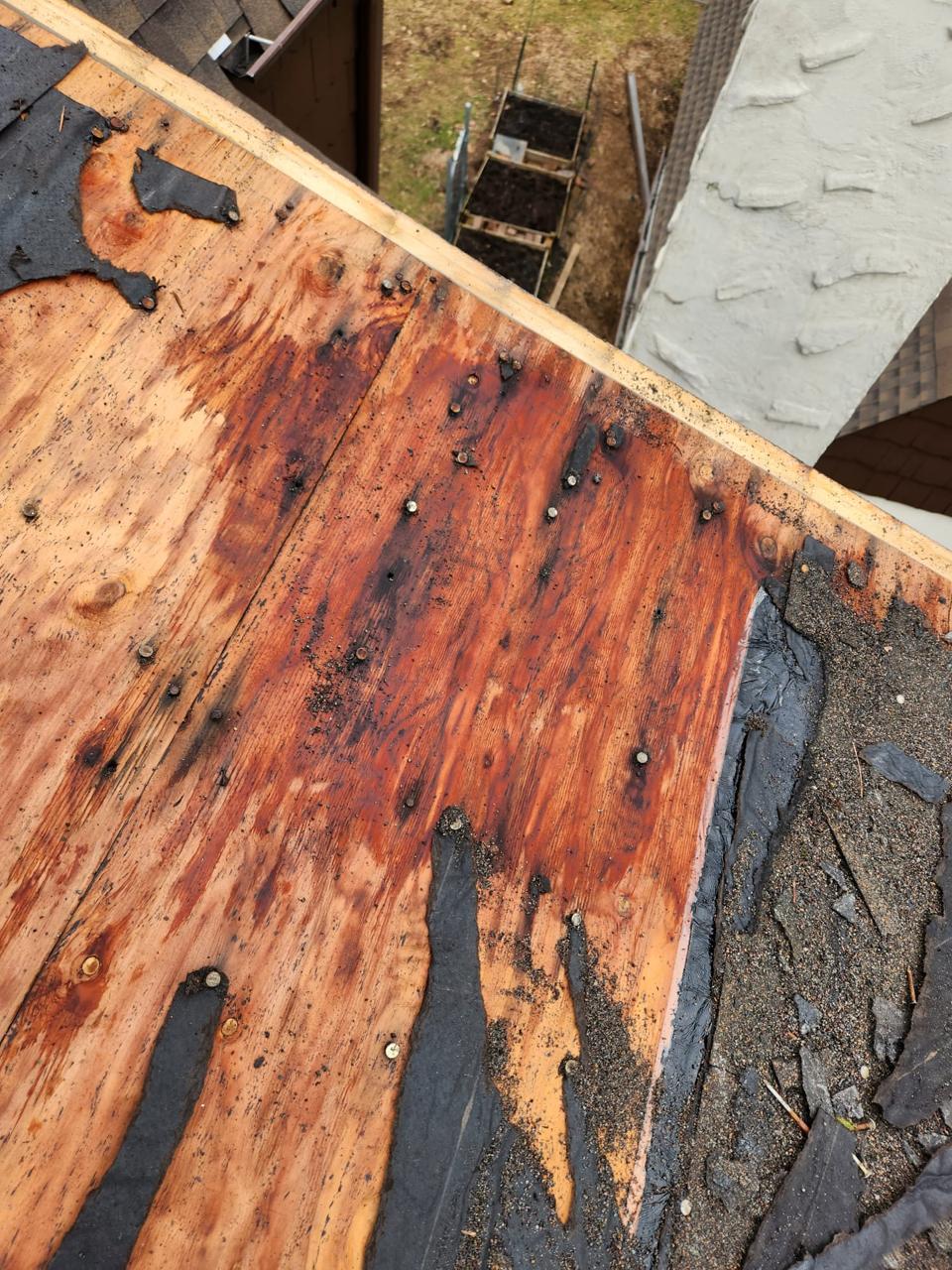
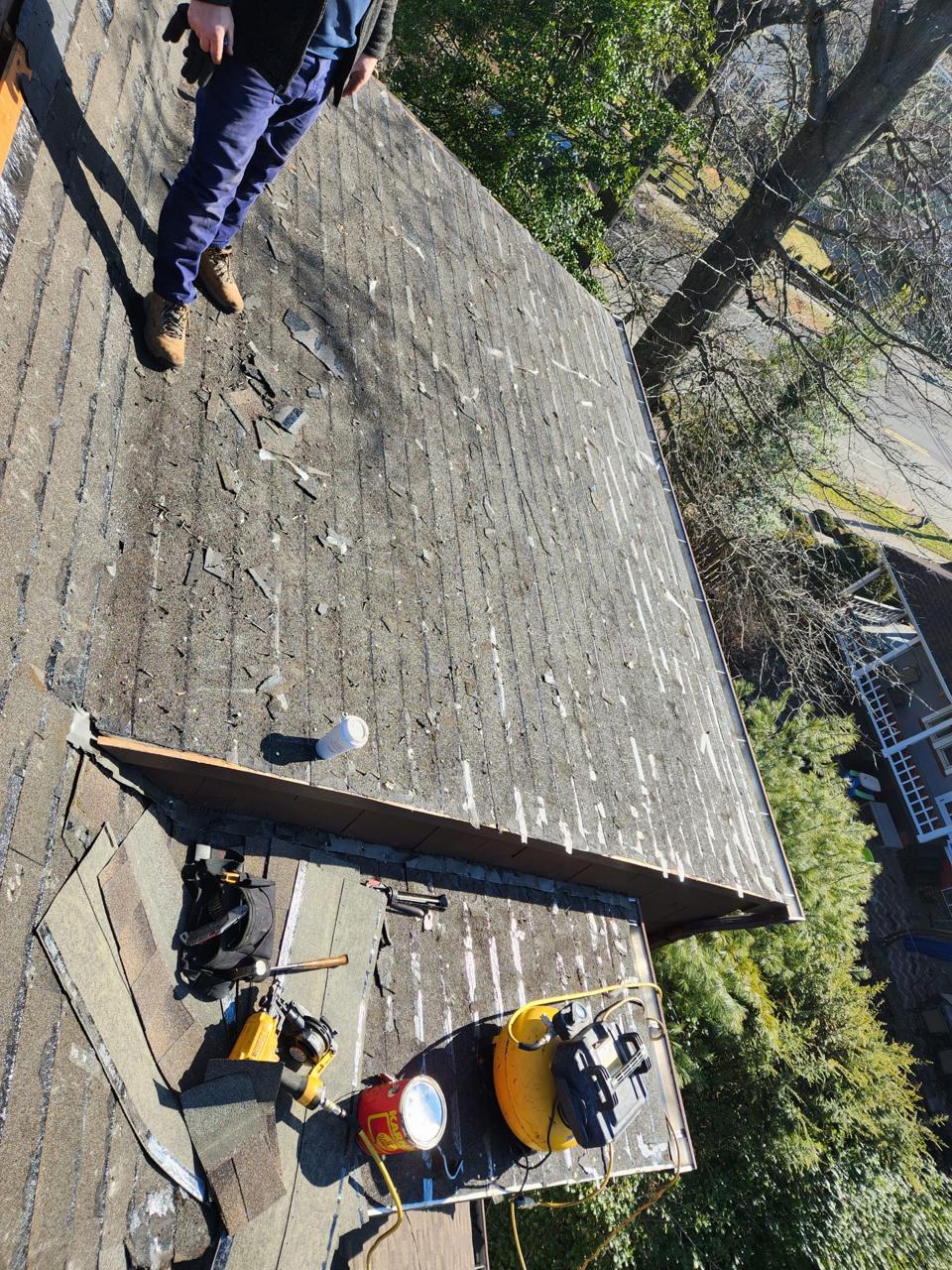
Our own photos show some of these conditions once the old roofing came off or while it was still on: split boards at a ridge in Little Falls, a dark stained plywood deck in Leonia, worn shingles with broken pieces in Leonia, and faded shingles with green growth in Rockaway. A roof does not have to look dramatic from the street to need work.
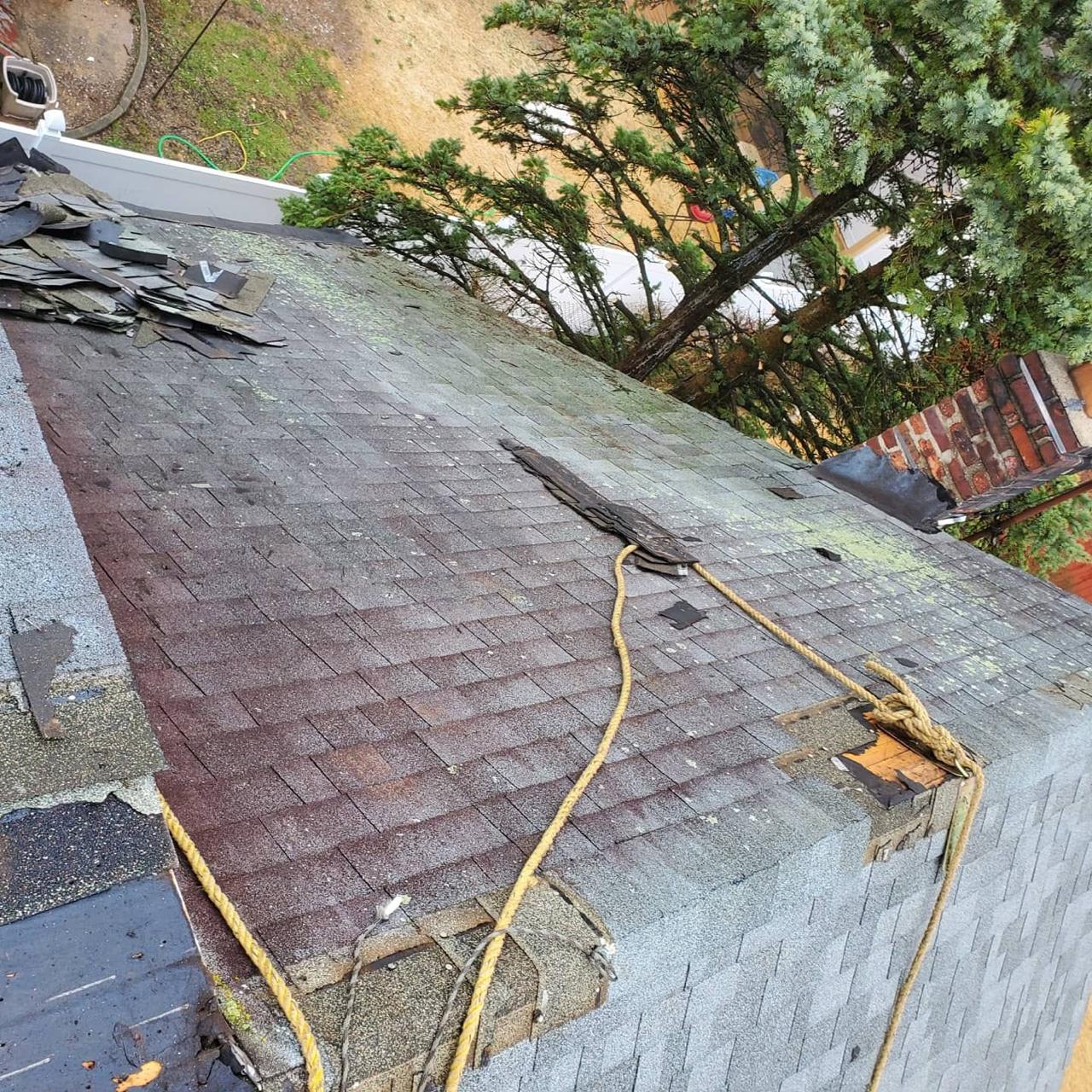
Not every roof problem is an emergency, but some should not wait for the next convenient week. A roof that is simply old can usually be planned: you can get estimates, compare them and choose a dry window. A roof that is letting water in, or that has been damaged by wind or a fallen branch, is different.
Treat these as urgent: water coming through a ceiling or running down a wall, shingles blown off or a section of roof left exposed, a tree limb on the roof, a sagging area of ceiling or roof, or daylight visible in the attic after a storm. Water near light fixtures or outlets is a safety problem as well as a roofing one.
While you arrange a repair, put a bucket under drips and move belongings out of the way, take photos of the damage from the ground and from inside, and keep any receipts. Do not climb onto a wet or steep roof to check it; a fall is a bigger risk than the leak. If the damage came from a storm, your homeowner's insurance policy may have reporting steps, so read it or call your insurer.
A temporary cover can protect an exposed section until a proper repair is possible, but it is a stopgap, not a fix. The damaged area still has to be opened up, dried and repaired. Call 973-935-6329 and describe what you see; photos help.
One damaged spot does not always mean a new roof. This is how the two cases usually differ.
| Repair may be enough | Replacement is worth discussing | |
|---|---|---|
| How much is damaged | A few shingles or one area | Wear across several slopes |
| Leaks | One leak with a clear cause | Repeated leaks or leaks in several places |
| Shingle condition | Mostly sound, with some storm damage | Curling, cracking, bare patches or heavy granule loss |
| Flashing | One failed joint | Problems at several joints |
| Deck | Solid underneath | Soft or sagging areas |
Repair may be enoughA few shingles or one area
Replacement is worth discussingWear across several slopes
Repair may be enoughOne leak with a clear cause
Replacement is worth discussingRepeated leaks or leaks in several places
Repair may be enoughMostly sound, with some storm damage
Replacement is worth discussingCurling, cracking, bare patches or heavy granule loss
Repair may be enoughOne failed joint
Replacement is worth discussingProblems at several joints
Repair may be enoughSolid underneath
Replacement is worth discussingSoft or sagging areas
A professional inspection tells a local problem from a problem with the whole roofing system. Eagle 1 repairs and replaces roofs. Request an estimate and describe what you see.
Request an estimateA repair may be enough for a few damaged shingles or one leak with a clear cause. Wear across several slopes, repeated leaks, curling or cracking shingles, problems at several flashing joints or a soft deck point toward replacement. An inspection tells the two apart.
It depends on the size of the roof, the number of slopes, the weather and how much decking needs work. Your estimate should explain the schedule for your roof.
On the jobs shown on this page, yes: the old roofing came off first so the deck could be checked. Whether a new layer can go over an old one depends on local code and the condition of the roof, so raise it when you compare estimates.
Damaged deck areas are repaired or replaced before underlayment goes on. Ask any contractor how extra deck work is priced and approved before it starts.
Rules vary by town. In New Jersey, replacing roofing material is often treated as ordinary maintenance that does not need a construction permit, but structural work, new openings such as skylights and some other changes can require one. Call your town's construction office before the work starts.
Flashing is part of the roofing system, so it is inspected during a replacement and reused or replaced depending on its condition and on whether it works with the new roof.
Yes. The Wayne project on this page includes two skylights set into a new roof with metal flashing around each frame.
Yes. Chimney repair, rebuilding, crowns, caps and chase covers are covered on our Chimneys page, and chimney flashing is inspected during every roof replacement.
We serve North Jersey, including Passaic, Essex, Bergen, Morris, Hudson, Union, Sussex and Warren counties. The roofs on this page and in our roofing projects are in Wayne, East Rutherford, Leonia, Bloomfield, Little Falls and Rockaway.
Use the Request an estimate button or call 973-935-6329. Tell us your town, what kind of roof you have and what you are seeing. Photos help.
It can be. Water coming through a ceiling or wall, shingles missing after wind or a section of exposed roof should be dealt with promptly, because water that keeps getting in can damage the deck, the insulation and the rooms below. Protect the room, take photos and call. A roof that is only old, with no water getting in, can usually be planned and priced without a rush.
Stay off the roof and look from the ground. Take photos of what you see, protect the rooms below if water is coming in and call a roofer to inspect. If you plan to make an insurance claim, check your policy's reporting steps and keep your photos and any receipts.
Look for missing, curled or cracked shingles, bare patches, granules in the gutters, dark streaks or green growth, ceiling stains and daylight in the attic. The chapter on signs your roof needs attention above has photos from our own jobs.
Send us a photo, your town and a rough idea of the size and we will tell you what we would do.